INTRODUCTION
As a person living in the 21st century, I get most of my work done from a little metallic box — one with a screen, some buttons with letters, and a small square sensitive to my touch, letting me move the cursor wherever I need it. This is not something new; it is exactly what we have all been shifting towards. Everyone works on computers now. But what keeps changing is the technology itself. These little metallic boxes become more and more efficient, lighter, and thinner — arguably even slimmer than your finger. And that means one thing above all else: more mobile.
That mobility changes everything. The way we work has quietly but fundamentally transformed and because of the mobility we are not only working from home, but any part of the world. Workers in the modern world are no longer tied to a desk in a fixed location; they can operate from any corner of the globe. Alongside this, we are seeing a large boom of freelancers — a rapidly growing segment of the workforce who are entirely self-employed and location-independent.
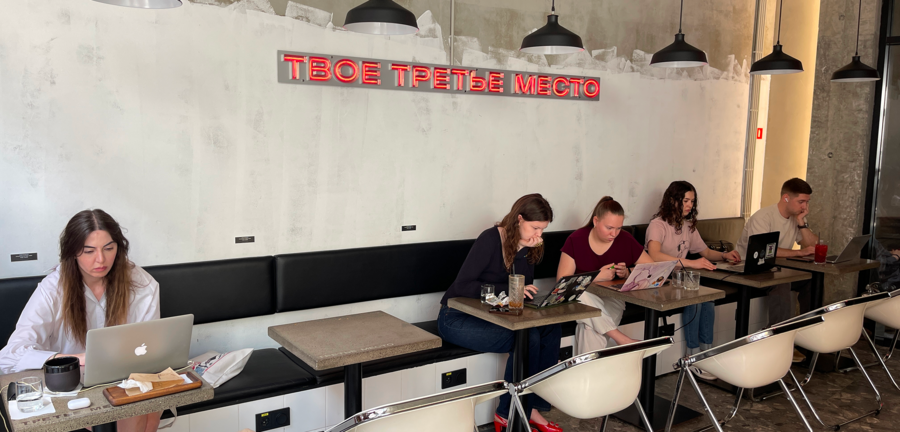
Mama Varit Coffee Cafe, Moscow, 2026
Forbes Advisor conducted research across the United States in 2025, finding that one in five workers was already working remotely — with a forecast that 32.6 million Americans would be working from home that same year. We are now in 2026, and that number has most likely only continued to grow. On top of that, 98% of workers surveyed said they want the option to work remotely at least some of the time, which speaks to just how deeply this shift has settled into the way people think about work.
The freelance market is going through its own transformation. Following the rise of AI, a whole new category of jobs began emerging — jobs done entirely online, and jobs that are in growing demand. A 2025 study published in the Journal of Economic Behavior & Organization tracked exactly this, finding that AI-complementary skills saw a significant surge. Things like machine learning, programming, and chatbot development — machine learning jobs alone grew by 24%, and chatbot development nearly tripled. The nature of independent, remote work is not shrinking. It is expanding, and it does not look like it is slowing down any time soon. With all of this happening, there is a small but telling observation to be made about the spaces around us — specifically, cafés. What were once places to meet friends, linger over a cappuccino, and have an unhurried conversation have quietly shifted into something closer to co-working spaces. Walk into most cafés during the day and you will not find tables full of people chatting. You will find rows of open laptops, people with headphones in, notebooks spread beside their keyboards. This shift in how people use cafés has had a direct effect on the spaces themselves. Cafés were originally built around one core idea: high customer turnover. Small tables, compact chairs, a layout designed to get people in and back out again.
But the modern visitor does not come for thirty minutes. They come for three hours. The furniture that once made perfect sense no longer fits the reality of how the space is being used. So what does this mean chair comfort, table size, surface space — all of it has to change?
A clear problem and tension emerges from this. Traditional café furniture was designed for short stays is not suited for long periods of work. This puts cafés in a difficult position: how do they maintain their commercial appeal — high turnover, a healthy average spend — while also offering a workspace that the modern visitor actually wants to come back to? How can the furniture and layout adapt to serve both functions at once?
The hypothesis is, «Café furniture design should be fully adapted to meet the needs of long-term users, prioritizing freelancers and remote workers over short-stay visitors.»
This research sets out to explore whether and how cafés have changed to meet the needs of the modern visitor, to look at existing solutions already present in the market, and to understand how — and whether — it is possible to combine the café experience with the functionality of a coworking space. More specifically, it will look at how compact workspaces within cafés can help maintain commercial viability while genuinely serving the people who now use them as their primary place of work.
Research plan
- WHAT DID CAFES LOOK LIKE BEFORE
- WHAT DID THE FURNITURE LOOK LIKE AT THAT TIME
- CAFES TODAY
- FURNITURE INSIDE THE CAFES TODAY
- CONCLUSION
WHAT DID CAFES LOOK LIKE BEFORE
Manwarings Coffee House, Estimated 1700, London, England
It is a little bit hard to trace the beginning of cafés, since they have existed for a long time — it was more of a gradual process. By the seventeenth century they were already quite popular in Europe, and became especially established in the eighteenth century. In England, France, and the Netherlands, coffeehouses evolved into important public spaces, shaping the development of compact, social, and mobile café furniture.
Early cafés and coffeehouses were not really about food in the way we think about it today. They were first and foremost places for conversation, news, business, and debate — spaces where people came to exchange ideas and be part of something.
Interior of a London Coffee-house, 1690-1700
In England they were even called «penny universities,» because for the price of a single penny you could get a coffee and sit among merchants, writers, scholars, and politicians. Over time they also became places for chess, backgammon, auctions, stockbroking, and trade meetings. As for who went — coffeehouses were generally open to a broad range of men from different social classes, though women were largely excluded. The crowd varied by location too; some coffeehouses drew traders, others poets, others political circles. But the common thread was always the same: people came to be around other people, to talk, and to participate.
Discussing the war in a Paris cafe, 17 September 1870, Illustrated London News
One of the most important observations is that early cafés were designed around shared seating and collective use. Instead of individual tables and separated chairs, people often sat on long benches or gathered around large communal tables, which allowed them to talk, read, and interact more easily. The furniture was simple, practical, and arranged to support conversation and public exchange, reflecting the café’s original role as a social space rather than a private or individual one.
From the 1830s onward, cafés began to shift. They were still places for conversation and intellectual exchange — especially in cities like Paris and Vienna — but they were slowly becoming something broader. Less tied to news, trade, and political organizing, and more connected to everyday urban life. Reading, leisure, art, people-watching. The café was growing up. The crowd changed too. Where early coffeehouses had largely been the territory of merchants, writers, and politically active men, the later café started drawing in artists, students, bohemians, and a wider educated public. Women and broader social groups began appearing more regularly, though access was still uneven and plenty of cafés remained firmly male-dominated for a long time. By the mid-19th century the café was no longer just a place for debate. It had become a space for all kinds of things — socializing, reading, working, watching the city go by. This is also the period when café culture started showing up in painting and literature as a symbol of modern urban life, which says something about how embedded it had become in the everyday.
Vincent Van Gogh, Café Terrace at Night, 1888
And as the way people used cafés changed, so did the furniture. The older model of long communal tables and heavy benches gradually gave way to smaller individual tables and lighter chairs. The space became more flexible, more adaptable — better suited to the mix of people now walking through the door.
WHAT DID THE FURNITURE LOOK LIKE AT THAT TIME
So now let’s take a deeper look at one of the most iconic pieces of café furniture of this period. We cannot get through this section without mentioning the Thonet Model No. 14 chair — a piece that helped define the visual language of the modern café and left a mark that is still visible today.
Thonet No.14 chair, Michael Thonet, 1859
The chair was designed by Michael Thonet, a German-born furniture maker who developed his work in Austria. What set him apart was his use of bentwood technology — a process of steaming and bending solid wood into curved shapes — which was genuinely new at the time, and allowed for a lightness and elegance that traditional furniture construction simply could not achieve. But what made the No. 14 truly remarkable was not just how it looked — it was how it was made and transported. The chair was built from only six pieces of wood, ten screws, and two nuts, and it was one of the first pieces of furniture ever designed to be shipped in parts. It could be disassembled, packed flat, and transported across Europe before being assembled at the other end with a simple set of instructions. That logic changed everything, and it is difficult not to draw a line between the No. 14 and the flat-pack thinking that IKEA would later build an entire industry around. At their peak, Thonet’s factories were producing over 865,000 bentwood chairs a year.
Thonet No.14 chair parts on display, Private Collection, 1859 Detail of Thonet No.14 chair leg with screw, , Private Collection, 1859
36 dismantled Thonet No.14 chairs, Courtesy of Thonet GmbH, year unkown
The chair appeared everywhere. It can be spotted in paintings by Henri Toulouse-Lautrec, and it is said to have been used by some of the most well-known figures of the time — Pablo Picasso had one in his studio, and Albert Einstein owned one too. It even made it onto film, appearing in some of the earliest movies ever made, including scenes from Sherlock Holmes Baffled, produced in the early 1900s.
At the Moulin Rouge, Henri de Toulouse-Lautrec, 1892 and 1895
Movie scene1, The burglar (far left) has gotten away!! ; Movie scene 2, A dressing gown does not a consulting detective make, Sherlock Holmes Baffled, 1900