Minimalism as an art movement emerged in the 1960s in the United States, particularly in New York, and was closely associated with conceptualism. The movement is linked to artists such as Donald Judd, Richard Serra, Carl Andre, Robert Morris, and Frank Stella. Largely a reaction against the then-dominant Abstract Expressionism, Minimalism sought a purity of form. In contrast to the emotional intensity of Abstract Expressionism and the consumerist preoccupations of Pop Art, Minimalism focused on the material itself, including industrially manufactured materials such as plastic and Plexiglas. In doing so, these materials were stripped of their functional purpose and transformed into works of art.
[title not known] (1967) Frank Stella
Minimalism drew upon a range of philosophical and aesthetic influences. In her influential 1965 essay on Minimalism, ABC Art, art critic Barbara Rose traces its origins to both the Soviet avant-garde and Dadaism. As Rose argues, Malevich and Duchamp each revolutionized art in their own way. Malevich, driven by the Romantic pursuit of metaphysical and transcendental experience, reduced form to its essence in the image of a simple black square. Duchamp, by contrast, approached art with irony and skepticism, challenging its conventions by declaring an ordinary found object to be art.
While both movements fundamentally transformed the way we understand form in art, another philosophical and spiritual tradition exerted a profound influence on the conceptual foundations of Minimalism: Zen Buddhism.
Where art had traditionally been expected to answer questions, convey meaning, express the artist’s emotions, or represent something beyond itself, Minimalism rejected these expectations in accordance with the principles of Zen philosophy. A minimalist object displayed in a gallery does not stand in for something else; it exists simply as an object with form and material, occupying a particular position in space. Through this approach, Minimalism establishes a new relationship between the viewer and the artwork: the viewer becomes aware of their own presence, their body, the surrounding space, and the air and light that inhabit it.
For instance, artist Robert Morris loved to say he doesn’t create sculptures, he creates situations. In such situation «one is aware of one’s own body at the same time that one is aware of the piece». This art piece perfectly works as an illustration of his principle. As the viewer walks around the four cubes, their mirrored surfaces produce complex and shifting interactions between gallery and spectator.
Untitled (1965) by Robert Morris
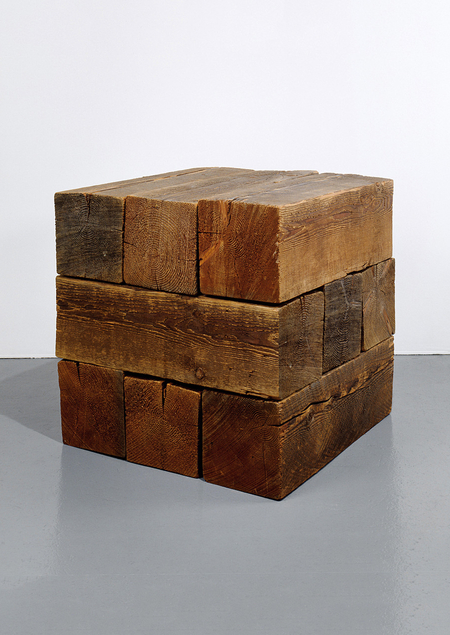
Carl Andre appropriates the same principle. His most signature works are made of wooden blocks, arranged variously in the exhibition space. Blocks are placed right on the floor, without any pedestal, how sculpture is regularly exhibited. What matters most is dimensions, proportions and arrangement in the space.
Photo from retrospective exhibition Sculpture as Place, Beacon, New York, 2014
In his essay Specific Objects, minimalist artist Donald Judd criticizes painting for neglecting the physical reality of the canvas and its inherent form. He points to artists such as Barnett Newman, who brought the rectangle itself and its shape to the forefront of the image.
Vir Heroicus Sublimis (1950) by Barnett Newman
Donald Judd himself preferred to work with three dimensional space, which he embraced in his manifesto. He worked mainly with such materials as galvanized iron, aluminum, stainless steel, brass, and copper. Thus, this industrial approach strengthened the midcentury tendency of an artist’s role as concept maker rather than producer of material objects.
Untitled (1990) by Donald Judd
The influence of Minimalism extends far beyond contemporary art. Within contemporary artistic practice, it has significantly shaped land art and artists like Olafur Eliasson, Robert Smithson and, to some extent, public art through its emphasis on the exploration of space. Architecture and industrial design have likewise embraced the minimalist principle of «less is more, ” helping to define the aesthetic sensibility of the present era.
«Your body of work» (2011) by Olafur Eliasson
Barbara Rose — ABC art (1965)
Donald Judd — Specific Objects (1965)
Minimalism in Art: The Complete Guide to its History, Techniques, and Cultural Impact / the artling// URL (https://theartling.com/en/artzine/minimalism-in-art-the-complete-guide-to-its-history-techniques-and-cultural-impact/?srsltid=AfmBOopovx0utbZ6WYBnZwodssGdneftLlARpGD-M7zov3KtQTtlpal5)
The 'Untitled', Robert Morris / Tate // URL (https://www.tate.org.uk/art/artworks/morris-untitled-t01532)
Brauchli M. Untitled // TateURL: https://www.tate.org.uk/art/artworks/morris-untitled-t01532
Carl Andre: Sculpture as Place, 1958–2010 // Dia Art Foundation URL: https://www.diaart.org/exhibition/exhibitions-projects/carl-andre-sculpture-as-place-19582010-exhibition
Donald Judd // Tate URL: https://www.tate.org.uk/art/artists/donald-judd-1378
Olafur Eliasson: Reality Machines // ArkDes URL: https://arkdes.se/en/exhibitions/olafur-eliasson-reality-machines/