Save Him — and He Will Save You
Rubricator
1. General theoretical part 2. Brand presentation for a wider audience 3. Presentation for a professional audience 4. How we arrived at this communication strategy 5. Bibliography and image credits
1. General theoretical part
In this project, communication is understood not as a simple transfer of information, but as a symbolic and relational process that unfolds within a broader system. A social poster functions as a medium where meaning emerges through the interaction between designer, viewer and context.

Anna Bolshakova. «Save Him — and He Will Save You»
Several communication traditions are directly relevant to social poster design:
—The rhetorical tradition treats communication as persuasion and explores how messages influence attitudes and actions.
— The semiotic tradition focuses on how visual signs images, colours, typography—create meaning and shape perception.
—The socio-psychological tradition examines how people process messages and change their beliefs, including through models such as the Elaboration Likelihood Model and cognitive dissonance.
— The critical tradition raises questions about whose voices are visible in public space and how power and inequality manifest through communication.
The project «Save him, and he will save you» brings these approaches together: it persuades (rhetoric), redefines the visual meaning of a stray animal (semiotics), works with attitude change (socio-psychology), and highlights how homeless animals are excluded from public discourse (critical perspective).
2. Brand presentation for a wider audience
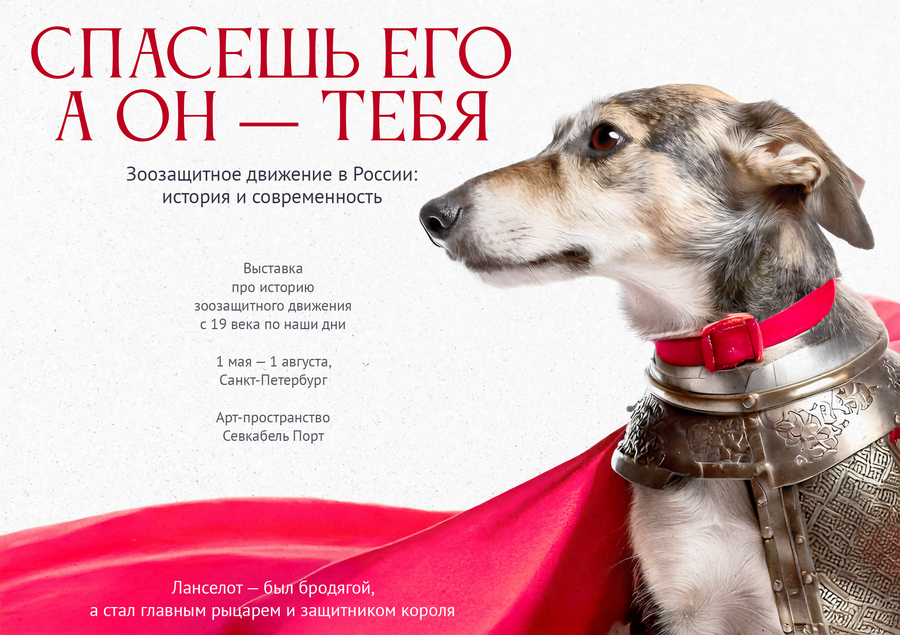
Lancelot is the central character of the project — a stray dog imagined as a knight and loyal protector of the «King», the person who saved him. The reference to Arthurian legend helps tell a familiar story of an outsider who becomes a hero. This metaphor mirrors the real path of homeless animals: once unwanted, with care and attention they can become devoted companions.
The main idea is expressed in the slogan:
«Save him — and he will save you.»
Anna Bolshakova. «Save Him — and He Will Save You»
Each poster presents a former stray dog or cat in knightly armour with a red cape. The frontal composition and direct gaze show the animals as confident and noble rather than helpless. The metaphor works on an emotional level: rescuing an animal today can bring support, loyalty and protection in return.
Rhetorically, the campaign builds on pathos (emotional portraits and the transformation narrative), ethos (trust in partner organisations), and logos (clear exhibition information).
From the socio-psychological point of view, the posters reach different types of viewers:
Those who actively engage with the text and story follow a central route of processing.
While others respond primarily to the expressive visual metaphor and the reciprocal promise, working through a peripheral route.
Anna Bolshakova. «Save Him — and He Will Save You»
The project also shifts the usual media framing of stray animals. Instead of representing them through suffering or pity, the posters offer an image of potential, dignity and mutual care: a stray can become someone who «saves» you through companionship and emotional support.
3. Presentation for a professional audience
Visual system and theoretical logic
Anna Bolshakova. «Save Him — and He Will Save You»
For designers, Lancelot is built as a focused visual identity constructed around a single, clear metaphor:
Anna Bolshakova. «Save Him — and He Will Save You»
Anna Bolshakova. «Save Him — and He Will Save You»
«stray animal = knight».
Armour, metallic textures and a bright red cape create a recognisable sign system: the animal is perceived not as a burden but as a protector or ally. The name «Lancelot» strengthens the narrative of someone once lost who becomes a trusted guardian.
Colour, type, layout
A minimal palette (white, deep red, dark grey) and a unified grid help the posters stand out in the city environment. Serif headlines combined with a neutral sans-serif text block reference museum exhibition design, keeping the tone respectful and structured.
Anna Bolshakova. «Save Him — and He Will Save You»
Psychological and critical aspects.
Large-scale portraits and direct eye contact foster a sense of personal connection with the viewer. At the same time, the project introduces a critical dimension: the posters give the animals an active, empowered role in the narrative and position them as participants in a public ethical conversation.
4. How we arrived at this communication strategy
The communication strategy emerged by taking specific components of the course and translating them into design decisions:
Rhetorical tradition — persuasion through respect rather than shock.
Instead of using distressing imagery, the campaign builds persuasion through admiration, empathy and clarity. This approach naturally led to the heroic visual language.
Semiotic tradition — creating a new code.
Understanding communication as the construction of signs guided the search for a metaphor that breaks stereotypes. Knightly armour and the red cape were chosen because they are culturally stable symbols of loyalty, bravery and protection.
Socio-psychological tradition — ELM and cognitive dissonance.
The posters combine expressive visuals with minimal text so that both central and peripheral routes of persuasion remain active. Showing a stray animal as a «royal knight» introduces a mild contradiction that invites the viewer to rethink previous beliefs.
Critical perspective and the public sphere.
Drawing on critical theory and Habermas’s ideas of public space, the posters are created not just as promotional material but as contributions to civic dialogue. The slogan’s reciprocity («he will save you») treats animals as subjects with agency, which supports the use of outdoor public formats and advocacy communication.
5. Bibliography and image credits
Course «Communication Theory: Bridging Academia and Practice», HSE University, 2024.
Craig, R. T. (1999). Communication Theory as a Field.
Griffin, E., Ledbetter, A., & Sparks, G. (2019). A First Look at Communication Theory.
Petty, R. E., & Cacioppo, J. T. (1986). Communication and Persuasion.
Festinger, L. (1957). A Theory of Cognitive Dissonance.
Habermas, J. (1989). The Structural Transformation of the Public Sphere.
Adorno, T., & Horkheimer, M. (1997). Dialectic of Enlightenment.
Concept, design and art direction: Anna Bolshakova. URL https://hsedesign.ru/project/89c6f3a9caf84466ba47d92ee907fdb9
Animal portraits and illustrations: created for the Lancelot project.
Mock-ups and exhibition visuals: produced within communication design and Communication Theory coursework at HSE School of Design.