Lug Vokrug: Communication Strategy

1. How does the theory of communication function in the context of sustainable branding?
In sustainable branding, communication is about making ideas like responsibility, care and thinking about the future clear and interesting. Brands use pictures, words and how they talk to people to tell not only about their products, but also about how they are good for the environment. In this way, brands are like a bridge between how people live and how nature is. They help us think about new ways to use things that are good for both people and the world.
Eco-friendly design uses communication to show that sustainable products are different from ordinary ones. Things made from natural materials can be a message themselves, showing that they are good for the environment. The way they look, how they feel, their colors, and their shapes make them special. They help people be more careful about what they do.
Both words and actions are important to make sustainability easy to understand. If we think of being green not as something bad, but as something good and interesting, it is easier to do every day. Stories are very important here. They change our thinking from feeling guilty or scared to feeling happy and proud when we help the environment.
Communication in eco-branding is not only about telling people about some things. It’s also about making people want to do these things. Good pictures, honest materials, and nice stories can turn ordinary things into symbols of how we can help the environment. They make it easier to see how we can be nicer to the world.
2. Presentation of «Luk Vokrug» for a general audience
Brand logo
Lug Vokrug is a brand of disposable tableware made from seed paper that transforms an ordinary picnic into an environmentally meaningful action.
In communication with a general audience, the brand avoids abstract sustainability discourse or complex ecological terminology. Instead, it offers a simple, intuitive, and emotionally engaging idea: a picnic that can be planted.
Lug Vokrug wants to show that taking care of the environment doesn’t need a lot of changes in your life. You can do it while having fun. For example, you can have a picnic with friends and family. The brand uses simple words that everyone can understand:
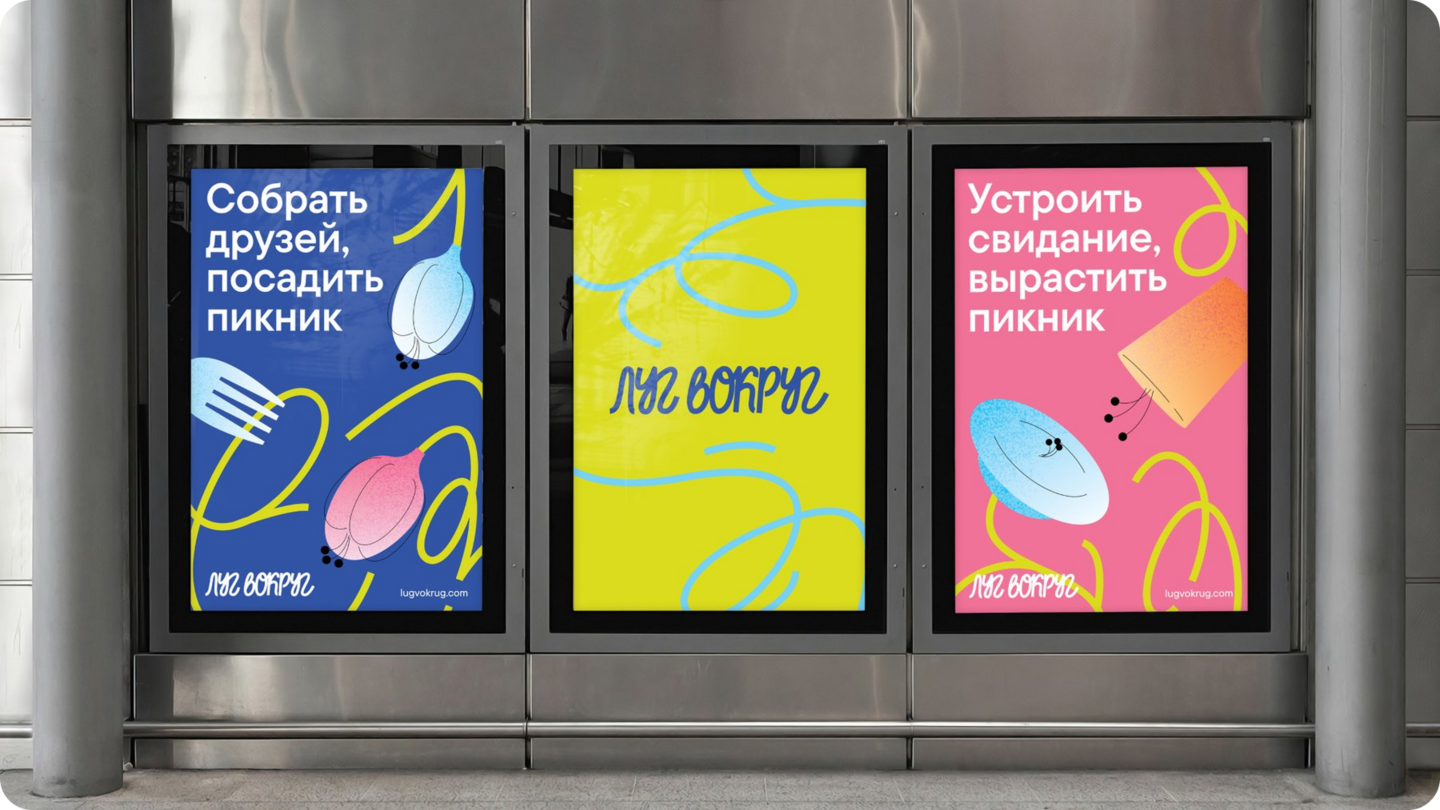
«Go out of town — plant a picnic» «Meet with family — grow a picnic» «Head into the steppe — plant a picnic»
Brand Slogans
These slogans show an action and an unexpected result. The picnic is not just one time, it is a process. After the table is used, it can be planted and become grass or flowers. So, Lug Vokrug makes disposable things actually good for nature.
The general audience of Lug Vokrug consists of people who regularly engage in outdoor leisure activities and value comfort, aesthetics, and responsibility in everyday choices. These are individuals and families who go on picnics, travel outside the city, meet friends in parks, or spend time in natural environments, but do not want their leisure to result in visible harm to nature.
This consumer is not necessarily an environmental activist. They are environmentally aware individuals who are not ready to significantly change their lifestyle. For them, ecological responsibility is about making better everyday choices within familiar routines.
Consumers' Profiles
Consumer’s point of view
As sustainability becomes a mainstream trend, consumers increasingly express ecological awareness through everyday lifestyle choices. Companies like Lug Vokrug make products that help people be more eco-friendly without changing their life too much.
Overall, Lug Vokrug talks to people in a way that is easy to understand. It uses simple, friendly language and creates a positive emotional response. The brand makes environmentally responsible choices look attractive, accessible, and easy to share, using natural, eco-associated colors that reinforce ideas of nature, growth, and care.
3. Presentation of «Luk Vokrug» for a professional audience
For designers, Lug Vokrug reveals itself not through statements, but through form, material, and system thinking. The brand redefines the purpose, meaning, and duration of disposable tableware.
From a visual and material perspective, Lug Vokrug avoids the stereotypical «eco» aesthetic. The tableware has a familiar, simple form, while the ecological message is embedded in the material itself. The tactile quality of seed paper (slightly rough, fibrous, visibly «alive») reinforces the idea of natural materiality. The awareness that the object contains seeds changes the user’s perception: it is handled more attentively, with a sense of anticipation of what comes next. Use becomes a transitional ritual rather than a final act.
Packaging plays a key communicative role. Floral motifs and bright colors act as visual cues of growth and regeneration, making the concept immediately readable without explanation. The product communicates its idea through touch, color, and material logic rather than through slogans or instructions.
Color also plays a central role in communicating these ideas. The palette — yellow, blues, pink, orange, and white evokes sun, sky, flowers, soil, and light, but in vibrant, contemporary tones.
In short, Lug Vokrug transforms disposable tableware into a medium for care and regeneration. The design strategy integrates material, color, and lifecycle thinking to communicate responsibility, optimism, and participation — qualities that resonate with both conscious consumers and those shaping the future of eco-design.
4. How did the communication theory course help us make this presentation?
Interpretive approach to communication
Before taking the course, our decisions regarding Lug Vokrug’s slogans, visuals, and overall messaging were largely intuitive. After studying the distinction between objective and interpretive theories, we intentionally adopted an interpretive approach. This approach views communication as the creation of shared meaning rather than the transmission of objective information. Lug Vokrug’s branding was therefore designed to emphasize values, emotions, and community agreement, helping the audience interpret the brand as positive, approachable, and environmentally responsible.
Semiotic tradition
Drawing on the semiotic tradition of communication, which understands communication as the sharing of meaning through signs and symbols, we analyzed how the product materials and visuals convey meaning. The seed paper’s rough, natural texture signifies authenticity and closeness to nature, while the bright packaging signals positivity and playfulness. Semiotics also helps explain the transformation of meaning associated with disposable tableware: disposable items are traditionally linked to convenience but environmental harm.Lug Vokrug redefines disposable tableware as environmentally beneficial, as it is biodegradable and can be planted.
Narrative Paradigm
The brand strategy also draws on Fisher’s Narrative Paradigm, which suggests that people understand the world through stories rather than isolated facts. Lug Vokrug constructs a simple but coherent narrative through its slogans: use the product, enjoy a moment outdoors, and then give something back to nature by planting it. This story extends beyond the moment of consumption and invites the audience to imagine a future outcome. For example, returning to the same place a year later and seeing tulips growing there.
Such a temporal continuation strengthens the story by linking present action with future. So the message of the brand is real and convincing. People feel involved in the story that they help make.
Social Identity Theory
Concepts from group communication, particularly Social Identity Theory, informed how the brand positions its audience. By engaging with Lug Vokrug, consumers symbolically affiliate themselves with a group that values environmental responsibility. This affiliation contributes to their self-image, as sustainable consumption becomes part of how they define themselves socially. The brand reinforces this identity by presenting eco-friendly behavior as socially visible and culturally valued, strengthening emotional attachment to the product.
Groupthink and normative influence
Finally, the concept of groupthink and normative social influence helps explain how Lug Vokrug encourages behavioral adoption. Environmentally conscious consumption is framed as a socially accepted norm rather than an exception. The visual appeal and shareability of the tableware support this dynamic by making sustainable behavior observable and desirable within social groups. As a result, individuals are more likely to conform to environmentally friendly practices, perceiving them as both popular and rewarding.
In short, the course helped us go from intuition to strategy. It showed us why colors, things, words, and actions are important. Lug Vokrug is not just plates and cups. It’s a small, everyday conversation about care, responsibility, and growth. And that’s exactly what makes the brand meaningful, memorable, and ready to connect with people: whether at a picnic, on social media, or in their everyday lives.
5. Sources
Communication Theory: Bridging Academia and Practice: электронный учебный курс. — Smart LMS HSE. — URL: https://edu.hse.ru/course/view.php?id=133853 (дата обращения: 13.12.2025).
Griffin E., Ledbetter A., Sparks G. A First Look at Communication Theory. — 10th ed. — New York: McGraw-Hill Education, 2018. — 560 p.
Fisher W. R. Human Communication as Narration: Toward a Philosophy of Reason, Value, and Action. — Columbia: University of South Carolina Press, 1989. — 220 p.
Chandler D. Semiotics: The Basics. — 4th ed. — London: Routledge, 2022. — 384 p.
Tajfel H., Turner J. C. An integrative theory of intergroup conflict // The social psychology of intergroup relations / ed. by W. G. Austin, S. Worchel. — Monterey, CA: Brooks/Cole, 1979. — P. 33–47.
Ottman J. The New Rules of Green Marketing: Strategies, Tools, and Inspiration for Sustainable Branding. — San Francisco: Berrett-Koehler Publishers, 2011. — 272 p.
Видео, сгенерированное с использованием инструмента Grok AI
«Луг Вокруг» https://hsedesign.ru/project/46b9a036bc6641b99514e71bf25d30be (дата обращения: 13.12.2025)
Фотографии из личного архива Манджиевой Кермен
https://unsplash.com/photos/man-wearing-pullover-hoodie-and-cup-standing-beside-plants-Xq-mI7Xhn4Y (дата обращения: 13.12.2025)
https://unsplash.com/photos/people-protest-with-signs-saying-hands-off-mother-QdDYTEEGElY (дата обращения: 13.12.2025)
https://unsplash.com/photos/photo-of-mother-and-child-beside-body-of-water-ry_sD0P1ZL0 (дата обращения: 13.12.2025)
Фотографии, сгенерированные с использованием инструмента ChatGPT