Author’s reasoning: how communication theory works in design
Design functions as organized communication: it selects what will be made visible, how it will be interpreted, and what actions will become likely. Communication theory matters in design because it treats meaning not as a «decorative layer» added after functionality, but as the condition that makes functionality legible and usable in the first place. The course frames communication as one of the most practical academic disciplines precisely because it operates across everyday interactions, public messages, and mediated environments.
Communication theory clarifies that messages are not simply «sent» and «received»; they are encoded, transmitted through a chosen channel, decoded, and often reconstructed differently from the original intent. This cybernetic insight maps directly onto design work: a product interface, brand identity, or service script is a structured message with a goal, a channel, and an expected decoding, while real users decode through attention limits, habits, and situational pressure. The course explicitly notes that what is decoded by a receiver can diverge from the sender’s message, even when a goal and a channel were carefully selected. Design quality, therefore, depends on reducing avoidable gaps between intended meaning and lived interpretation.
Communication theory also supports design decisions about persuasion and public discourse. Digital environments amplify the importance of matching form to context: images may carry attention and affect, while text may carry explanation and justification. The course highlights that choosing an appropriate channel and mode (visual vs. textual, interactive vs. static) changes how messages attract attention and how arguments are processed. In design terms, this becomes a method for deciding when to emphasize clarity and evidence (central processing) and when to rely on cues such as tone, rhythm, and visual credibility (peripheral processing).
Design is never neutral within culture. The course’s critical perspective emphasizes context, power balance, and ideology as forces shaping what counts as «common sense» and what becomes normalized through mediated communication. Design participates in this social construction: interfaces distribute agency, policies define acceptable conduct, and visual hierarchies privilege some narratives over others. A communication-theory lens therefore requires examining who benefits from a designed system, whose friction is treated as acceptable, and which assumptions are silently encoded into defaults.
Finally, design is produced through group communication, not only consumed through it. The course defines group communication as the exchange of information and symbols to achieve shared meaning over time, and describes teams as task-oriented groups focused on a joined goal. In practice, design outcomes depend on alignment between roles, shared vocabulary, and stable interpretive frames inside the team. The course’s discussion of online collaboration stresses co-creation of shared reality rather than mere «generation» of information — an especially accurate description of contemporary design processes, where meaning is negotiated iteratively through critique, revision, and artifact-based discussion.
Presentation for a general audience
Welcome to a day where coffee doesn’t start with a line. NoQueue shows how busy nearby places are and lets you reserve a spot in advance — so you arrive at the right time, not «just to try your luck». Everything is clear at a glance: simple statuses, a simple choice, no extra fuss.
Choose a place nearby. See where it’s quieter. Tap «Join the queue» or «Pick a time» — and keep living your life while the app holds your spot. One screen, one meaning: straightforward, no confusion.
The best part is the feedback. The app tells you when to come: a quick notification, a confirmation, a reminder. No standing by the counter, no checking «how’s it going». A queue turns into a clear timeline.
It saves real days: weekday lunch when every minute matters; a campus coffee run between classes; weekend family plans when everything is packed and decisions have to be made fast. One service, many moments — because it follows your context, not the other way around.
Trust, without bureaucracy. Your data is used only to run your booking and queue, and it’s protected under personal data regulations. If you need help, support is there in plain human language.
NoQueue: see the load, save your spot, show up on time.
Presentation for a professional audience
This project is a digital queue management platform created for cafes and other places of entertainment owners to control customers flow and reduce peak-hour overload.
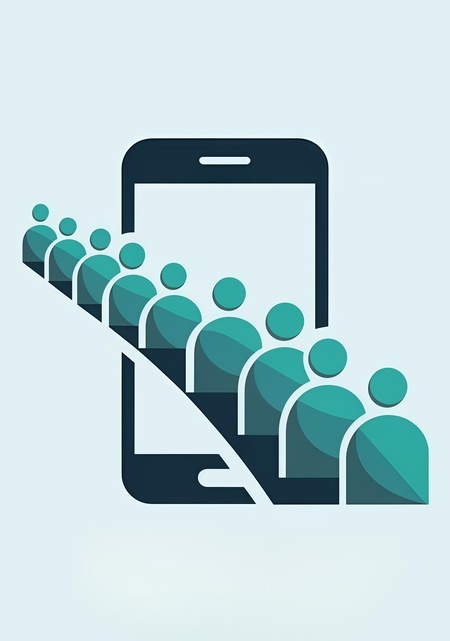
Create a photorealistic image of a long queue at a cafe
The app solves a number of consumer problems
- Peak-hour overload, customers turn away when they see a queue.
- Sudden and unpredictable spikes in visitor flow, especially on weekends.
- Revenue and customer loss due to lack of data on waiting time and actual venue load.
- No historical analytics: main idle periods, peaks, active days and hours are unknown.
- Limited throughput capacity with no possibility of expanding the physical space.
- Intuitive, unrecorded management of customer flow without proper data.
- Inability to effectively plan shifts, staff schedules and supply purchases.
- Manual reservations lead to overlaps and conflicts.
- Weekdays remain empty while weekends are overloaded — no load balancing.
It is important to note the benefits for business from using this service
- Increased throughput without hiring extra staff or expanding the venue.
- Reduced customer refusals through time-based distribution of visitor flow.
- Access to accurate real-time and historical data on visits.
- A digital tool for monitoring and analyzing venue load.
- Ability to offer online queueing and table reservations via the app.
- Optimization of staff schedules and procurement planning.
- Improved comfort and loyalty among regular and corporate clients.
- Load forecasting and targeted recommendations for visitors.
Priority Segments
— Chain cafes in business districts (Coffee & Work) — the most promising segment with high purchasing power, readiness for digital tools and a clear pain point: peak-hour queues. They have resources for rapid implementation.
— Family cafes in residential areas (Lemonade) — suffer from uneven customer flow and need effective load management. Ready to adopt the solution if the interface is simple and the cost is moderate.
— Small coffee shops near universities (DobroCoffee) — a scalable segment, suitable for rollout after testing with higher-budget partners. They value simplicity and affordability.
Cost Structure
— App development: 4M rub — Technical support: ~400k rub/month — Marketing launch: 1.1–1.6M rub — Updates and improvements: ~100k rub/month — Other expenses: 400k rub/month
Total: 11.5M rub Fixed costs: support, updates, operations, marketing. Variable costs: transaction fees (2% of check).
Create pie diagramm with the cost structure based on the provided data, with monthly expenses annualized for clarity.