Fragility in Contemporary Contexts
Introduction
Cambridge dictionary says, that fragility (/frəˈdʒɪl.ə.ti/) is «the quality of being easily damaged or broken», or «the quality of being easily harmed or destroyed». And often it is straight — fragility is often understood as a condition of breakability. Yet in contemporary contexts, fragility emerges as a defining framework through which to read the political, ecological, and affective dynamics of the present. Thinkers like Félix Guattari, Giorgio Agamben and Judith Butler have demonstrated that fragility operates not only at the level of individual bodies or objects, but within the structural fabric of our social relations, our environments, and the processes through which subjectivity is formed. Rather than a passive state of vulnerability, fragility marks the unstable equilibrium on which modern life is built, revealing the pressures, exclusions, and exposures that define our collective condition.
This essay approaches fragility as a central lens for understanding contemporary reality, tracing its conceptual foundations and exploring how it reconfigures our thinking about vulnerability, interdependence, and collective existence. Across ecological, political, and social frames, fragility emerges as an analytical and aesthetic strategy — one that reveals hidden fractures within prevailing structures while opening space for new relations, sensitivities, and modes of transformation.
Fragility in ecological context
In ecological terms, fragility refers to the delicate interdependence and vulnerability of natural systems under accelerating environmental change. It reveals how stability is always provisional, maintained through precarious balances that are easily disrupted. This dynamic is powerfully articulated in Olafur Eliasson’s Ice Watch, which materialises ecological fragility as a public, sensory encounter.
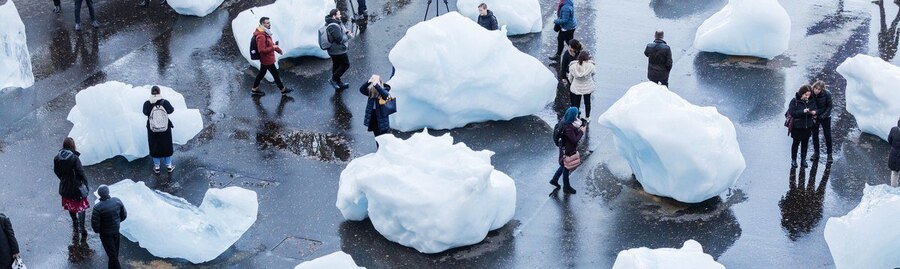
Ice Watch (2014–2018) is a large-scale installation by Olafur Eliasson and geologist Minik Rosing, first presented in Copenhagen during the release of the IPCC’s Fifth Assessment Report. For the work, large blocks of glacial ice were harvested from the waters of Greenland, where they had already naturally detached from ice sheets, and transported into urban public spaces. Each iteration responded to a specific political moment, using the presence of ancient melting ice to confront audiences with the immediacy of climate change.
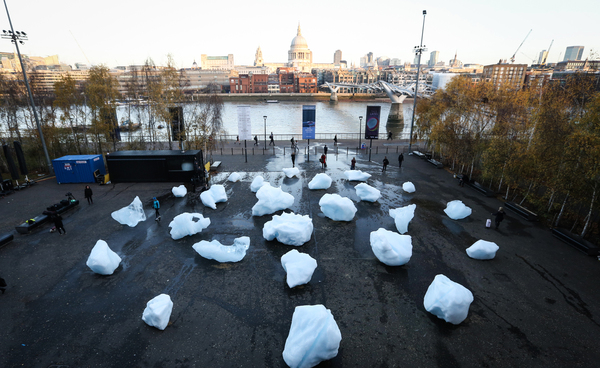
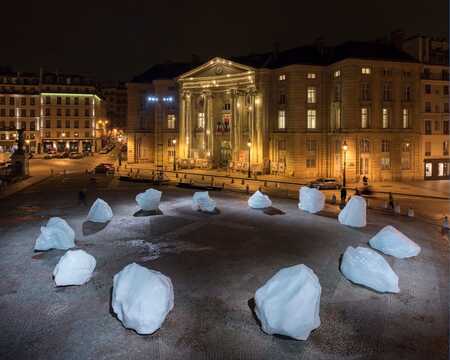
Ice Watch installations in London and Paris.
Viewed through this lens, Ice Watch may be understood as an embodied demonstration of ecological fragility; that is, what appears monumental and timeless reveals itself as fragile, unstable, and already disappearing. By relocating glacial ice into a city, the work collapses geographical and temporal distances, making viewers witnesses to processes that normally unfold far from human perception. Its slow melting functions as a temporal narrative, exposing how climate change operates through irreversible loss and delayed consequences. Rather than offering didactic explanation, the work relies on sensory confrontation-touch, sound, temperature, weight-to provoke reflection on responsibility, interdependence, and the fragility of the ecosystems that sustain life. In this way, Ice Watch reframes environmental change as a shared, present, and urgent experience.
Wheatfield — A Confrontation
Agnes Denes’s Wheatfield — A Confrontation (1982) is another work, that contributes to this theme. It was a land-art project in which the artist planted and maintained a two-acre wheat field on a landfill site in Lower Manhattan, directly adjacent to Wall Street and the World Trade Center. Over four months, Denes cultivated the crop using standard agricultural methods, eventually harvesting nearly a thousand pounds of wheat. The project was documented extensively and later exhibited internationally.
The meaning of Wheatfield lies in its sharp juxtaposition of fragile organic life with the hyper-capitalist machinery surrounding it. By placing a vulnerable crop in the shadow of financial skyscrapers, Denes exposes how easily living systems are overshadowed—or outright ignored—by structures driven purely by profit. At the same time, the field quietly reveals how unstable those systems really are: a patch of wheat can suddenly make the global economy look oddly brittle and out of touch. In this way, the work turns fragility into a critical lens, suggesting that care, slowness, and shared vulnerability might offer real alternatives to the extractive logic of necrocapitalism.
Fragility in political context
In political contexts, fragility refers to the subtle, often invisible ways social rights, protections, and civic guarantees can erode under pressure. It highlights how seemingly stable systems—democracy, welfare, access to justice—can fracture when economic inequality, bureaucratic neglect, or social division intensify. This type of fragility becomes especially visible in cultural works that show how easily social security and civic stability can unravel. Bong Joon-ho’s Parasite (2019) offers one of the clearest contemporary illustrations of this phenomenon.
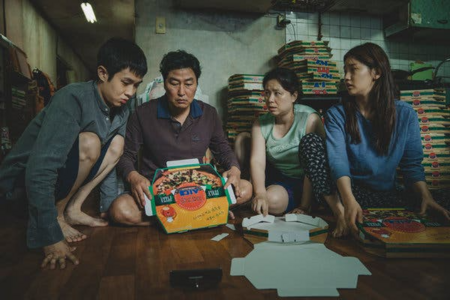

Scenes from «Parasite»
Bong Joon-ho’s Parasite (2019) captures political fragility through the everyday precarity shaping its characters’ lives. Emerging amid rising inequality and housing insecurity in South Korea, the film shows how civic stability can erode quietly when structural conditions fail to protect those most vulnerable. The Kim family’s unstable work and improvised survival strategies reveal a political system too fragile to guarantee basic rights, while the Parks’ insulated comfort conceals these fractures until they violently surface. Through this contrast, Parasite demonstrates how political fragility appears first at the margins.
Fragility in social context
In the social sphere, little attention is given to the fragility of human and non-human life — people neglect these awarenesses in order to maintain the rhythm of ordinary life. Yet some contemporary works foreground and radicalize the recognition of mortality, making it central to their aesthetic and conceptual approach. This is precisely what Have A Nice Life’s «Deathconsciousness» articulates.
«Have A Nice Life — Deathconsciousness» (album cover)
The album’s title speaks for itself — you are quite literally always «conscious» about «death», constantly reminded of how fragile your existence truly is, both in biological terms and through the instability of social bonds that are rarely secure. Deathconsciousness amplifies this condition, showing how the awareness of mortality permeates not only the body but also the tenuous structures that hold communities together. The album frames this continual confrontation with fragility not as melodrama, but as a fundamental dimension of living in a world where both life and connection can collapse with minimal force, proving this type of storytelling with a seventy-page booklet, that contains «lore» of the album.
But if we are talking about fragility of social connects, Take Care of Yourself (2007) made by Sophie Calle is resonating the most. It begins with a deceptively simple event: Sophie receives a breakup email from her partner. Instead of replying, she hands the letter to 107 women from different fields — lawyers, dancers, psychologists, opera singers — asking each to interpret, analyze, or «solve» it according to her expertise. The project eventually becomes a vast archive of readings, transforming one personal rupture into a collective, multi-voiced document.
Sophie Calle — Take Care of Yourself
At first glance, it feels like Calle is just externalizing a personal crisis, but the work cuts much deeper. It exposes how fragile social bonds really are, and how a single message can quietly dismantle an entire shared reality. By scattering her breakup across so many voices, Calle shows that any relationship is shaped not only by two people but by the broader web of expectations, projections, and silent assumptions around them. The piece suggests that a breakup isn’t a clean break at all — it’s a messy, ongoing process of interpretation, where everyone is trying to make sense of something that’s already slipped out of control.
Conclusion
Across ecological, political, and social terrains, fragility appears not as a peripheral condition but as a defining logic of the contemporary moment. It exposes how systems assumed to be durable — from natural environments to civic protections and even the bonds that hold communities together — are held together by precarious balances that can shift or break with minimal force. Recognising fragility means acknowledging the instability beneath the surfaces of modern life, but also understanding that this instability offers a unique vantage point: a way to perceive the world more attentively, to sense pressures that remain invisible in more rigid frameworks, and to imagine forms of care, responsibility, and relation that do not depend on false assurances of permanence. In this sense, fragility becomes both a diagnostic tool and a generative force — an invitation to rethink how we coexist within a world defined as much by its vulnerabilities as by its capacities for renewal.